Five-million-year-old whale graveyard teeming with life discovered in Indian Ocean
Scientists have discovered an astonishing five-million-year-old whale graveyard in the Indian Ocean, described as "far beyond anything we had imagined" and teeming with life.
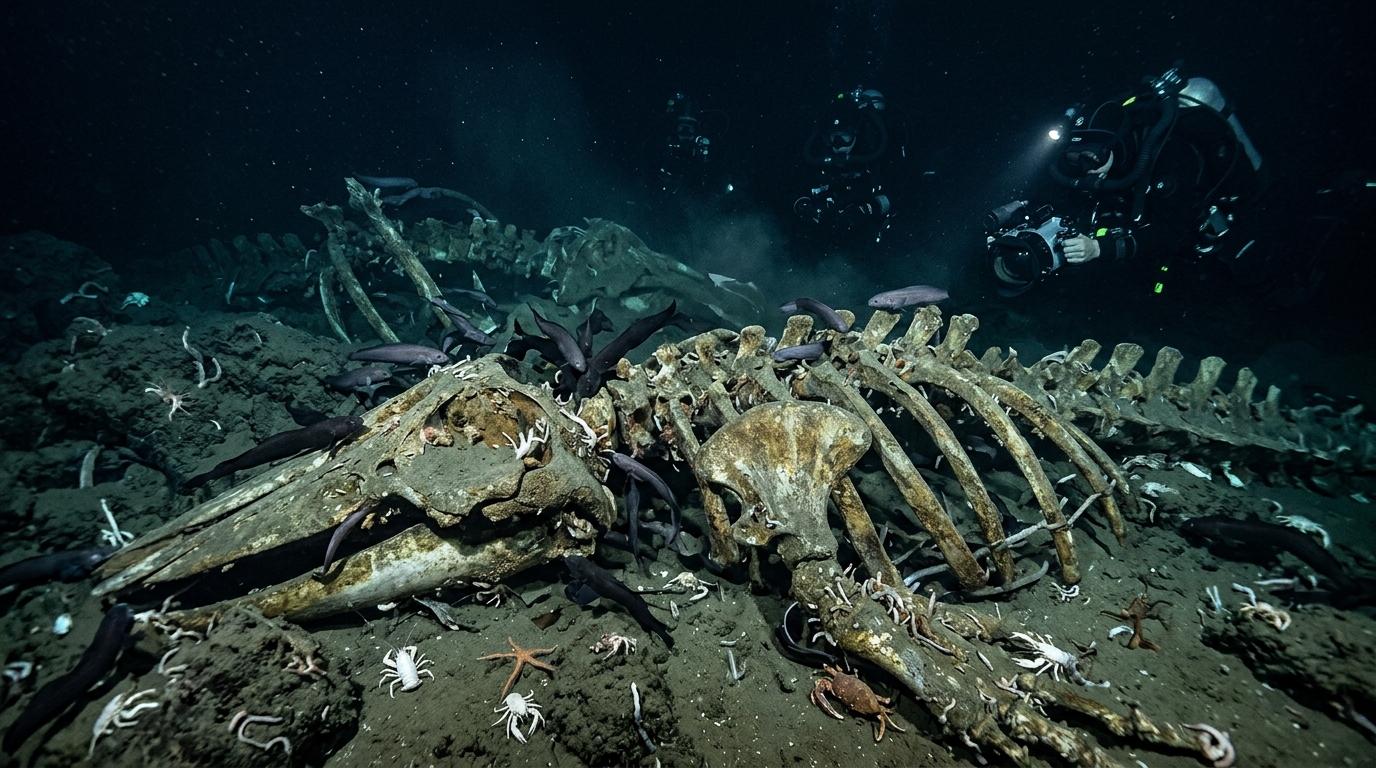
Image is an AI-generated illustration, not a real photograph.
Scientists have uncovered an extraordinary five-million-year-old whale graveyard stretching for hundreds of miles across the southeastern Indian Ocean. This immense deep-sea "megasite," named the Diamantina Zone necropolis, is the largest, deepest, and oldest accumulation of whale fossils and carcasses ever documented, with some remains dating back 5.3 million years.
The discovery is teeming with diverse marine life, forming thriving ecosystems around the whale falls—the sunken carcasses. Researchers observed various creatures, including jellyfish, tubeworms, brittle stars, sea cucumbers, squat lobsters, and bone-eating worms, with many species potentially new to science. These complex communities provide crucial insights into how life adapts and flourishes in extreme deep-ocean environments characterized by an absence of light, low oxygen, and immense pressure.
A collaborative team from institutions in China, Italy, and New Zealand explored this remarkable site using the Fendouzhe submersible. Their findings, detailed in a recent study published in the journal Nature, offer a unique window into ancient deep-sea biodiversity and the evolutionary history of marine life.
What each outlet emphasizes
- BBC: reporting on the five-million-year-old whale graveyard discovered in the Indian Ocean, described as 'far beyond anything we had imagined'
- AP: highlighting the discovery of a deep whale graveyard that is 'teeming with life'
Read it at the source
livescience.com ↗ washingtontimes.com ↗ popsci.com ↗ theguardian.com ↗ iflscience.com ↗