Uncovering the 'Adams and Eves' of Facial Recognition Technology
New reports delve into the foundational figures and early developments that paved the way for modern facial recognition technology.
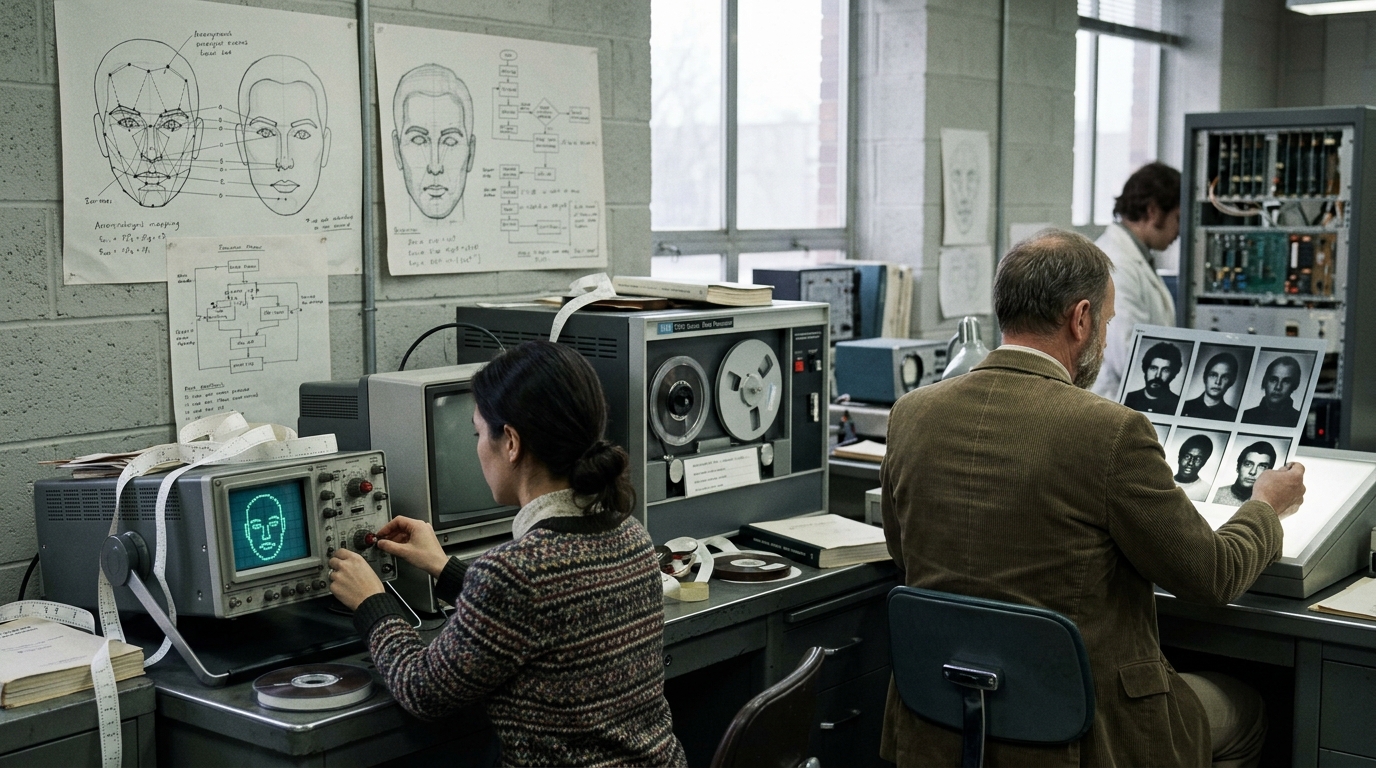
Image is an AI-generated illustration, not a real photograph.
New reports highlight the pioneering individuals and early innovations that laid the groundwork for modern facial recognition technology. The initial foray into this field began in the 1960s with the work of Woody Bledsoe, Helen Chan Wolf, and Charles Bisson. Their "man-machine" approach involved humans manually pinpointing facial features on photographs using a graphics tablet, which a computer then used for recognition and comparison. This semi-automated system aimed to teach computers to identify human faces by analyzing coordinates of features like eye corners and hairlines.
Further advancements in the 1970s saw Takeo Kanade develop an early face-matching system that could automatically locate anatomical features and calculate distance ratios between them, reducing the reliance on human intervention. The 1990s marked a significant leap with the introduction of the Eigenface method by Matthew Turk and Alex Pentland. This technique utilized principal component analysis (PCA) to represent faces, allowing for more efficient and, for the first time, real-time facial recognition by focusing on how faces deviate from an average.
These foundational efforts transitioned facial recognition from a primarily manual process to increasingly automated and mathematically sophisticated systems. The work of these early researchers established the core principles and algorithms that continue to influence the development of facial recognition technology today, paving the way for its widespread applications in various sectors.
What each outlet emphasizes
- CNN: the historical figures and origins of the technology
Read it at the source
wikipedia.org ↗ mobbeel.com ↗ lystface.com ↗ midextimeandattendance.com ↗ wesleyan.edu ↗