Six months into Iran war, Middle East grapples with new security architecture
Six months after the onset of the Iran war, the Middle East is navigating a new and complex security landscape, with Gulf states forming alliances and the US-Iran conflict rippling outwards.
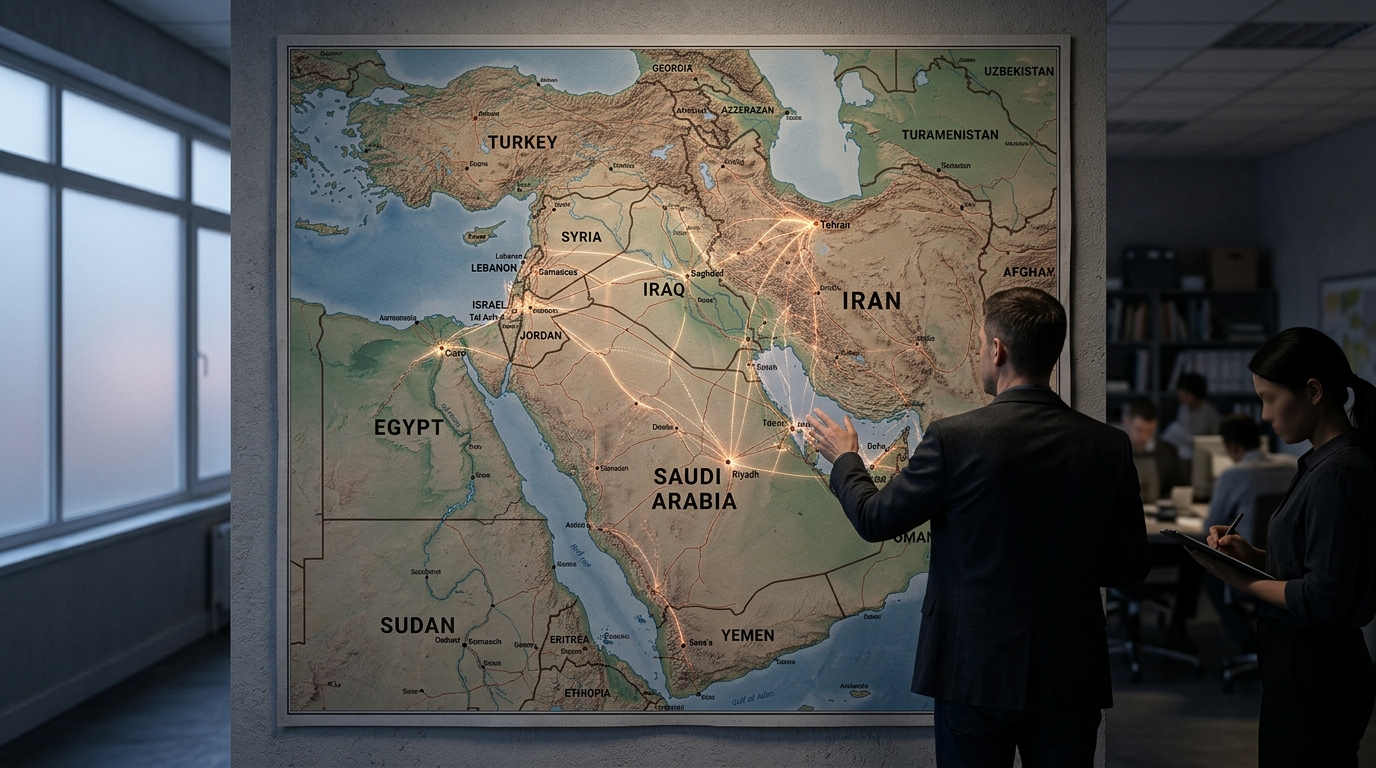
Image is an AI-generated illustration, not a real photograph.
Six months after the United States and Israel launched joint military strikes against Iran on February 28, 2026, the Middle East is navigating a dramatically altered security landscape. The initial attacks, which targeted Iranian military infrastructure and leadership, resulted in the death of Supreme Leader Ali Khamenei. In retaliation, Iran unleashed hundreds of missiles and drones across the region, impacting Israel, Lebanon, and Gulf Arab states, and controversially asserting control over the vital Strait of Hormuz. This escalation has led to widespread destruction, thousands of casualties, and millions displaced, with the conflict quickly expanding into a broader regional war.
The ongoing conflict has profoundly reshaped regional alliances and security perceptions, particularly among Gulf states. These nations, witnessing the vulnerabilities exposed during the war, are now actively pursuing new, overlapping partnerships to bolster their defense capabilities, rather than solely relying on the United States for security. Despite a Pakistan-mediated ceasefire and a memorandum of understanding in June, significant fighting has persisted, with the US implementing "Operation Economic Outcast" through further sanctions to cripple Iran's economy and isolate it globally.
The war, initially aimed at transforming the Middle East through military force, has instead resulted in a more hardened and radical Iranian regime, according to some analyses. The US-Iran confrontation continues to ripple across the region, straining international relations and raising concerns about freedom of navigation in key waterways. This ongoing instability underscores a complex and evolving security architecture where regional actors are increasingly seeking diversified partnerships and indigenous defense capabilities amid persistent tensions and unresolved core disputes.
What each outlet emphasizes
- CNN: highlights Iranian Americans' division and a reporter visiting a school struck by a US missile
- AJ: emphasizes Iran pledging to stand firm against sanctions and the emergence of a new Gulf security architecture
- AP: states the Iran war has changed the Middle East, but not as hoped by its architects
- BBC: mentions Somali piracy surging as an impact of the US-Iran war
Read it at the source
britannica.com ↗ wikipedia.org ↗ theguardian.com ↗ aljazeera.com ↗ mecouncil.org ↗