First Radio Signal Detected from a Planet Outside Our Solar System
Scientists have detected a radio signal originating from a planet beyond our solar system for the first time, marking a significant milestone in exoplanet research.
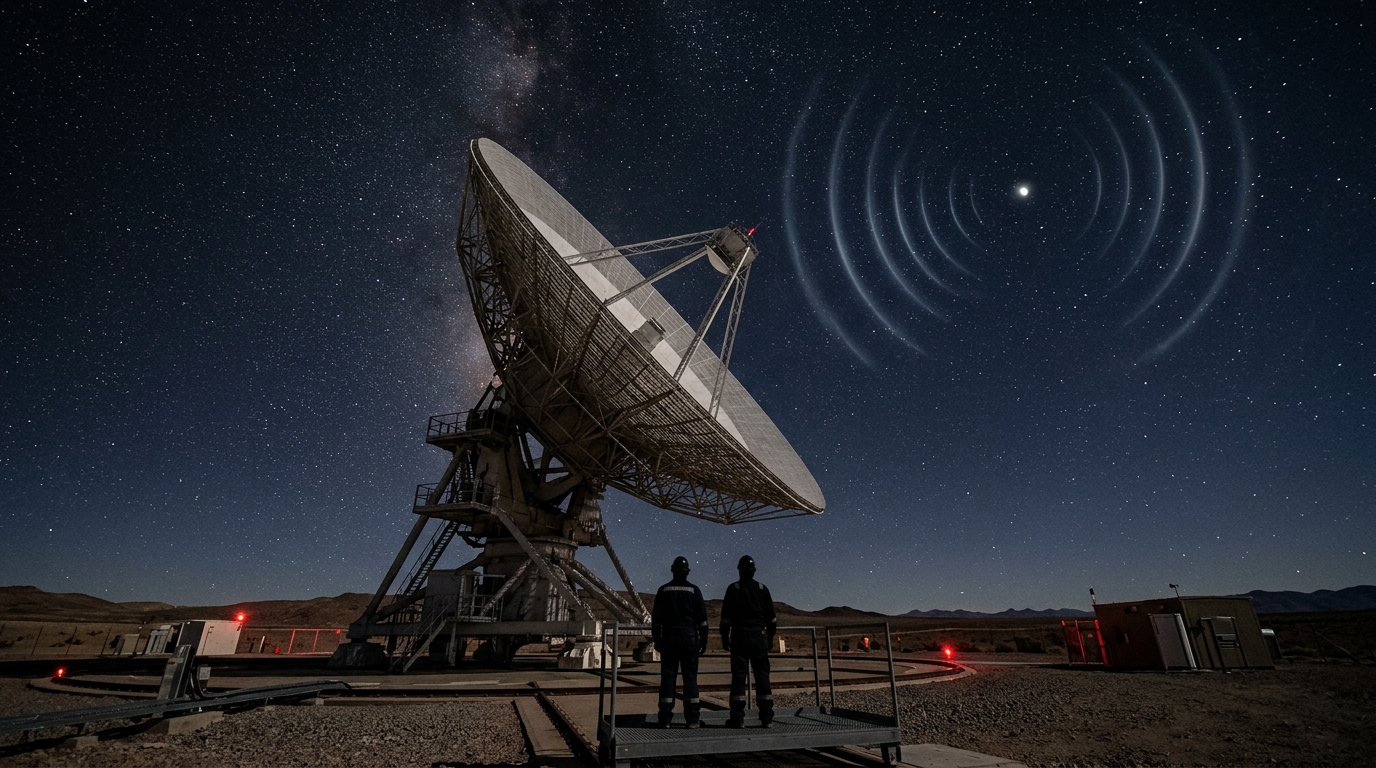
Image is an AI-generated illustration, not a real photograph.
For the first time, scientists have detected a radio signal originating directly from a planet outside our solar system, marking a significant advancement in exoplanet research. The signal was traced to Beta Pictoris b, a massive gas giant located approximately 63 to 64 light-years from Earth. This groundbreaking observation was made possible using the MeerKAT radio telescope array in South Africa, following multiple observational runs between 2025 and 2026.
Researchers confirmed that the detected radio emissions are a natural phenomenon, specifically a radio aurora, similar to the Northern and Southern Lights seen on Earth and other planets within our solar system. Crucially, astronomers were able to unambiguously localize the signal to Beta Pictoris b, distinguishing it from its host star, a challenge that has hindered previous attempts to detect exoplanetary radio emissions.
This discovery allowed for the first direct measurement of an exoplanet's magnetic field, revealing Beta Pictoris b possesses a magnetic field thousands of times stronger than Earth's. Understanding these magnetic fields is vital as they can play a critical role in protecting planetary atmospheres from stellar winds, a factor considered important in assessing a planet's potential for habitability. The findings were reported in a preprint research paper.
What each outlet emphasizes
- CNN: reports the first-time detection of a radio signal from an exoplanet
Read it at the source
ubergizmo.com ↗ newsweek.com ↗ futura-sciences.com ↗ sciencenews.org ↗ livescience.com ↗