Millions Prepare for Total Solar Eclipse Visible Across North America and Europe
Millions across North America and Europe are preparing to witness a total solar eclipse today, with scientists deploying new instruments and satellites capturing the moon's shadow.
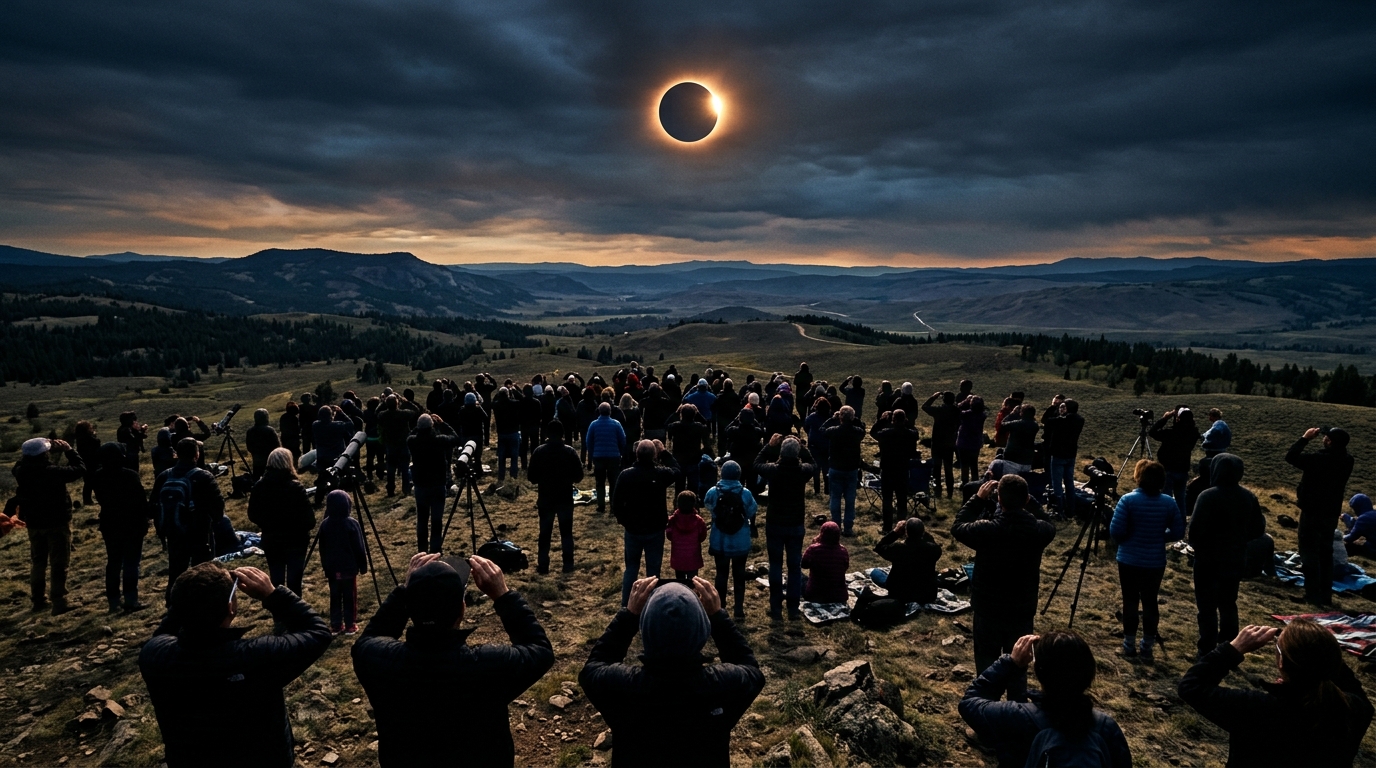
Image is an AI-generated illustration, not a real photograph.
Millions across North America and Europe are poised to witness a total solar eclipse today, August 12, 2026, marking a rare celestial event. The path of totality, where the Moon completely obscures the Sun, will sweep across northernmost Siberia, the Arctic, Greenland, Iceland, a segment of the Atlantic Ocean, northern Spain, and the extreme northeastern part of Portugal. Outside this narrow band, a partial solar eclipse will be visible to a much wider audience, encompassing most of Europe, West Africa, and parts of northern North America. For those within the path, the maximum duration of totality, lasting approximately 2 minutes and 18 seconds, will occur off the western coast of Iceland.
Scientists are capitalizing on this unique opportunity by deploying advanced instruments and satellites to study the Sun's atmosphere. NASA's WB-57 aircraft is slated to chase the Moon's shadow at high altitude over the North Atlantic, extending observation time of the solar corona to nearly three minutes. Meanwhile, the European Space Agency's (ESA) Proba-3 mission, utilizing two satellites in precise formation to create an artificial eclipse, will provide continuous views of the inner corona, a region typically obscured by the Sun's brightness.
Further scientific endeavors include observations from the ESA-led Solar Orbiter mission, which is conducting a special campaign to image the Sun's atmosphere and gather data to refine predictions of the corona's behavior. These coordinated efforts aim to enhance understanding of the superheated corona, the origin of the solar wind, and the broader dynamics of space weather, which can influence Earth's technological infrastructure.
What each outlet emphasizes
- CNN: emphasizes live updates, satellite captures, and scientific mapping/instrument testing
- BBC: highlights the rush for viewing glasses and the countdown in the UK and Europe
- AJ: focuses on the timing and visibility locations of the eclipse
- The Guardian: covers viewing preparations, safety tips, and the impact on travel/hotel prices
- AP: provides guidance on where and when to catch the eclipse in North America and smartphone photography tips
Read it at the source
wikipedia.org ↗ nasa.gov ↗ esa.int ↗ space.com ↗ nationalgeographic.com ↗